
Your Lodge Is Irrelevant
They're asking how to survive. We're debating the dress code.

Did it work.. did you click.. now that you’re here.. I apologize for the intentionally inflammatory click bait title.. but it was for a good cause I promise.
A nurse I’m aware of has been in the profession for nineteen years. Started at twenty-three dollars an hour. She now makes thirty. Seven dollars. That is what nineteen years bought her while housing doubled, healthcare tripled, and daycare for two children climbed past thirty thousand a year.
Someone told her she should stop buying coffee.
Ten dollars a day on coffee is three hundred a month. That is real money. Now put it next to what it actually costs to be alive right now.
Adjusted for inflation since 1980, the average home should cost around two hundred thousand dollars. It costs over four hundred thousand. Finance that at six percent over thirty years and you will pay another four hundred sixty-four thousand in interest. Property taxes on a sixty-thousand-dollar house in 1983 ran six hundred a year. On a four hundred-thousand-dollar house they run three to five thousand. While saving for a down payment they cannot reach, people are renting at fifteen hundred to two thousand a month where inflation-adjusted rent should be nine hundred.
“We had fourteen percent interest rates in the 80s.” You did. On sixty-thousand-dollar houses. Briefly. Then you refinanced into payments most people today would mistake for a car note. Fourteen percent on sixty thousand and six percent on four hundred thousand are not the same conversation.
College tuition that a summer job once covered now takes twenty years to pay off. Healthcare for a family of four runs twenty-seven thousand a year through an employer plan, and every dollar the employer “contributes” is compensation you are not receiving as wages. Daycare runs twelve to fifteen thousand per child. Two kids for two years is sixty thousand dollars, roughly what a lot of the people offering advice paid for their entire house.
A woman I know told me her great-aunt was a custodian her entire career and owned property. A custodian. Try that sentence today.
Someone else said they always thought six figures would mean they had made it. It means the bills get paid, maybe a little left over, and one car repair away from a very bad month.
Add it all up and the cumulative overpayment for a millennial or Gen Z household runs well past a million dollars. For many families it approaches two million. Not because they refuse to work. Because the cost of the same middle-class life that one income supported forty years ago now requires two incomes, sixty-hour weeks, and an acceptance that retirement might not happen.
I know a lot of boomers. I am a Freemason, and roughly seventy-five percent of our membership are boomers and older. Many of them are among the finest people I have ever known. That is a fact, and I hold it without contradiction alongside the next thing I am going to say.
A person can be genuinely good, honorable, self-aware in every dimension of their life, and still be flatly wrong about the economy because they have not participated in significant parts of it for twenty or thirty years. If you have not rented an apartment, applied for a mortgage, priced daycare, or opened a student loan statement since 1992, your intuitions about what those things cost are wrong by six figures. That is not a character flaw. It is an information gap. But when that gap gets expressed as “stop buying coffee” or “I worked hard and so should you,” it does not land as wisdom. It lands as contempt.
Which brings me to Freemasonry, and what I think we are getting wrong.
We are trying to answer a question nobody is asking.
Grand Lodges are commissioning studies on membership retention. Lodges are workshopping their social media presence. Committees are debating whether the problem is programming, or marketing, or the building, or the ritual, or the dress code. I have participated in many of these conversations. I have led some of them. I have written about them at length on this Substack and in my books. And I have come to believe that we are missing what is actually happening outside our walls by a distance so large that our well-intentioned efforts are functionally irrelevant to the men we say we want to reach.
The question that men are asking, increasingly, exponentially, every single day, is not “where can I find fellowship” or “how do I become a better man” or “what does Freemasonry offer.” But something simpler. Harder. More desperate.
“How do I survive?”
How do I keep the lights on, the kids fed, the car running, the student loans current, the marriage intact, and my sanity somewhere within arm’s reach while working sixty hours a week for a paycheck that covered this life twenty years ago but does not cover it now? That is the question. And we are not answering it. We are not even in the room where it is being asked.
These men are exhausted. They are carrying the full weight of the economic reality I just described, and they are doing it while absorbing a daily barrage of noise that would have been unthinkable a generation ago. Ignorant commentary from people who have not done the math in decades. Workplace politics that demand performance reviews and emotional regulation from people running on four hours of sleep. Thought police from every direction, ready to destroy a career over a misread sentence. Rage baiters algorithmically designed to hijack whatever emotional bandwidth is left. And then, at the end of the day, Orwell’s prolefeed, the rubbishy entertainment and spurious news piped through every screen in the house, engineered to tell you what to think while pretending to let you relax.
These men and their families are spread thinner than any generation in living memory, and they are being told by comfortable people that the problem is their attitude.
Freemasonry was not always irrelevant to this kind of pressure. There was a time when lodges functioned as mutual aid societies. Brothers took care of brothers. Widows and orphans received real, material support, not a framed certificate and a sympathy card, but food, rent, medical care, and a community that showed up with tangible help when the bottom fell out. That was an era before government social programs funded by our taxes attempted to fill that role. I do not think the return on that particular investment has been all that impressive, but that is an aside for another essay. The point is that Masonry once occupied a space in men’s lives that was not decorative. It was structural. It held weight. It bore load.
Most Worshipful Brother Cameron Bailey, writing on Emeth, has been making the case for why Freemasonry still matters, why he keeps putting electrons into cyberspace on behalf of this institution. I read him and I agree with every word. The Craft is worth the fight. I have written my own version of that argument here on Square Thoughts, and I have written specifically about the economics, about what it really costs a young family man to attend a stated meeting when you account for the babysitter, the gas, the dinner donation, the opportunity cost of four hours away from his family, and the cascading effects that ripple through the rest of his week. I have written about why lodges that charge less than a streaming subscription are announcing that they believe Masonry is worth less than entertainment.
I stand behind all of it. But I do not think I went far enough.
The economics pieces I wrote were aimed inward. They asked how we price Masonry to reflect its value. That is a valid conversation. But it assumes a man who has the margin to invest. What about the man who does not? What about the man who would be a Mason in his bones, who would show up and do the work and become exactly the kind of brother we say we are looking for, but who cannot afford to add one more obligation to a life that is already running on fumes? What do we offer him?
Right now, the honest answer is nothing. We offer him a petition fee, a background check, annual dues, and the expectation that he will attend meetings on weeknights when he is already choosing between overtime and his kid’s baseball game.
I think there is a different answer, and it does not require writing checks from accounts that do not have the money.
Most of us have buildings. Lodges, temples, halls, whatever you call yours. And most of those buildings sit completely empty for over three hundred days a year. Even accounting for multiple appendant bodies sharing the space, the vast majority of the calendar is dead air and dark rooms. We heat them, insure them, maintain them, and they sit. Waiting for the next stated meeting. The next spaghetti dinner that we throw for ourselves.
Here is what I think we should do, and I think it is so simple that the simplicity itself will make some Brothers suspicious.
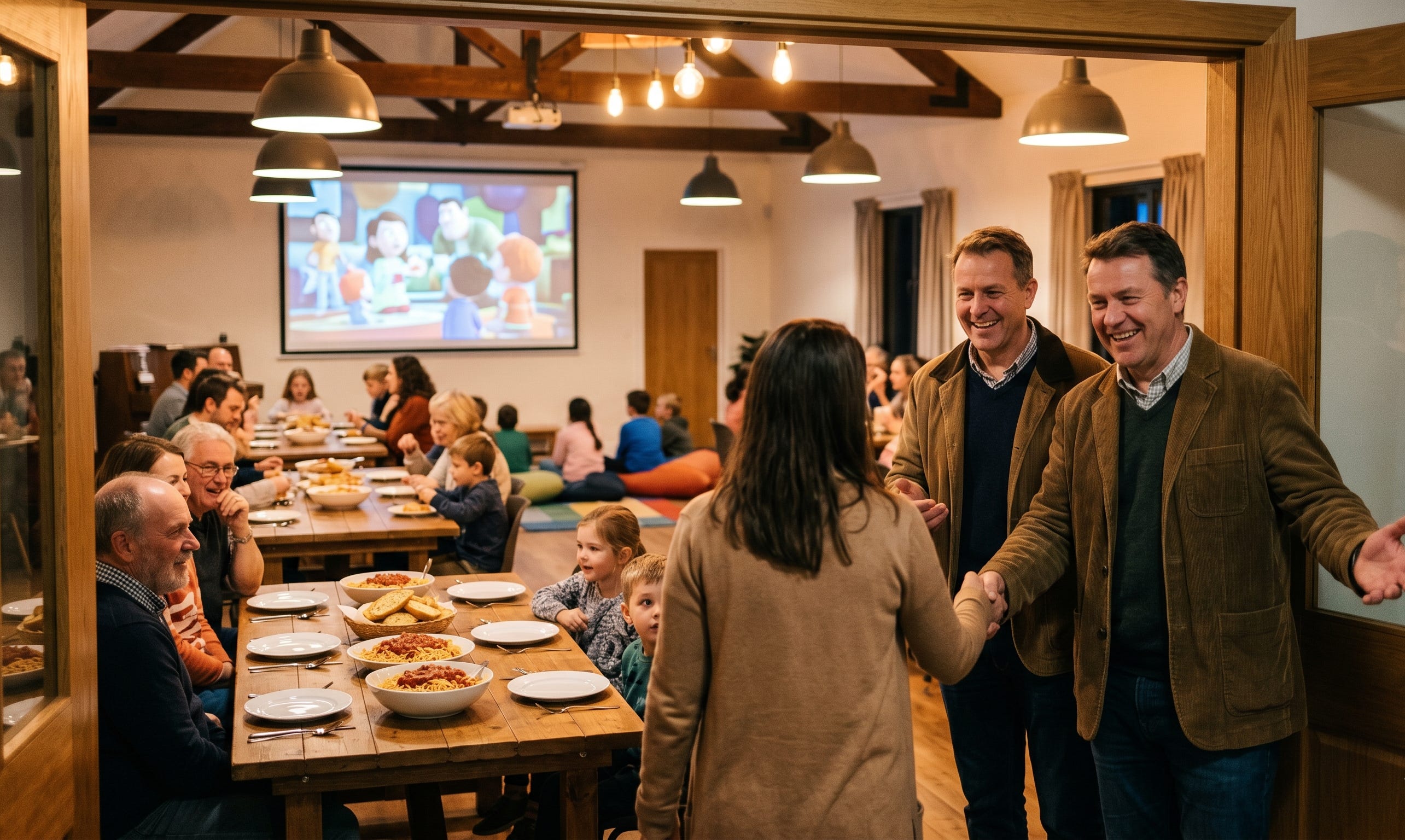
Host a dinner. Not a fundraiser. Not an event. A dinner.
Go to your Gordon Food Service, your Sysco, your US Foods, your Costco. Buy noodles. Buy number ten cans of marinara. Buy garlic bread. Buy a ten-pound bag of frozen meatballs. Heat all of it up. Set the tables. Open the doors. And invite families in to eat.
No agenda. No pitch. No petitions on the table. No “so, have you ever thought about joining?” No raffle tickets. No donation basket. Do not ask for a single thing in return. Just a meal. That is it.
If you have a back room, put on cartoons or a family movie. Set out pitchers of water from the tap. Mix up some Kool-Aid. If you are feeling generous, put on the coffee, even the cheap stuff that barely turns the water brown, the stuff we always have brewing anyway.
And then just be there. Be a pillar in that room. Keep the plates full. Welcome people at the door. Keep an eye on the kids who wander off to watch the Mario movie in the other room and make sure they do not escape the building. Let parents sit for an hour. Let them eat a meal they did not have to cook, clean up after, or budget for. Let them breathe. Let them unburden themselves for sixty minutes in a space that is asking absolutely nothing of them.
That is relief. Not symbolic relief. Not “thoughts and prayers” relief. Actual, tangible, a-family-did-not-have-to-figure-out-dinner-tonight relief.
Every human being has a claim upon our kind offices. We say that. We charge our candidates with it. And then we go back to arguing about whether the building needs new carpet.
You may never bring a single one of those families in as members of your lodge. That is fine. That was never the point. But the kind of man we say we want, the one we are actively seeking, the one who would make a good Mason, he will hear about what you did. Or he will see it. He will see men in a community actually giving a damn about the weight that modern families are carrying, not performing concern for a social media post, not running a canned food drive and calling it charity, but opening their doors and standing in the room and feeding people who are tired. And that man will appear. I have seen it happen.
We cannot fix the economy. We cannot undo the two-million-dollar generational deficit. We cannot make housing affordable or erase student debt or bring healthcare costs back to something sane. Those fights belong to other arenas and other institutions, most of which are failing at them spectacularly.
But we have buildings. We have kitchens. We have Brothers who know how to cook. We have tables and chairs and plates and forks. We have doors that lock and rooms that are warm and men who swore an oath to care for the distressed.
Use them.
Lord, make me an instrument of your peace.
-Brother Rob
Brotherly Love, Relief, and Truth.
Your topic reminds me of a question I asked VWB Clayton a while ago when a Brother was dealing with a cardiovascular event. We have a bunch of programs and charities, but very few help to as you so very well articulated here, carry the load.
If an individual had 400 years to accumulate wealth they should theoretically have time on their side and amass vast sums of resources that would baffle the mind. Why have many of our Lodges failed to do the same? Our Lodges should be better primed to support our Brethren and their families today than at any other point in history. We shouldn't event need to worry about the dues that many of us rely on.
If we start to approach this intentionally we could make a meaningful impact for future Masons and ensure the Legacy not only endures, but thrives.
Keep up the Great Work Brother, I really appreciate your posts.
Thank you for your kind thoughts Brother.