
What Are We, Really?
Lodge Purpose part 1 of 3

Last week I talked about what the world gets wrong about Freemasonry and what we get wrong in our own defense. The conspiracy crowd imagines something sinister. Most brothers respond by flattening the fraternity into something harmless. Neither version is true, and the honest middle, that Masonry contains real depth that isn’t dark but is serious, never gets said out loud.
I said it out loud. Now I want to turn the lens inward.
Just Observe
Set aside what you were told Masonry was when you petitioned. Set aside the language from the Grand Lodge website. Set aside what you hope your lodge is becoming. Just observe.
What is your lodge, right now, as it actually exists?
I used to use a framework in coaching built around three layers: having, doing, and being. What do you have? What do you do? Who are you becoming?
Apply that lens to your lodge. I’ll use a composite of three lodges I know well, and I suspect the picture will look familiar.
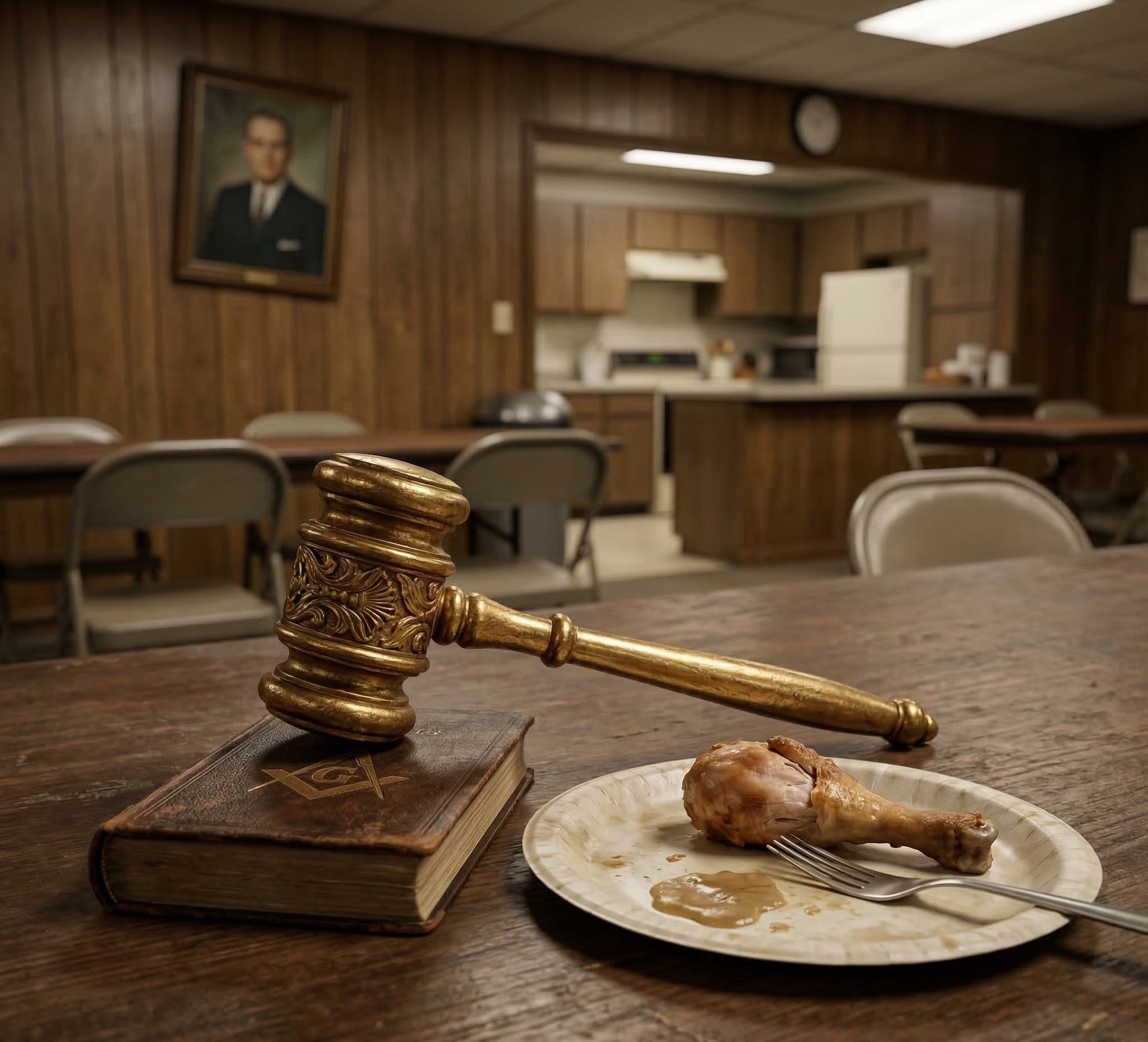
Having. The lodge has a building. Furniture, regalia, maybe a portrait of a past master from 1947 hanging slightly crooked in the dining hall. A bank account. A charter on the wall.
Doing. The lodge meets once a month. The members eat a meal together. They sit through a business meeting. They socialize. Some months there’s a degree. Some months there isn’t.
Being. This is where it gets quiet. You can argue the higher meaning of Blue Lodge Masonry. You can quote ritual. You can point to the philosophical depth that lives inside the degrees. But the observable reality for roughly eighty percent of lodges is this: we are a building association that meets for dinner monthly, conducts a business meeting, and socializes with a group of men we’ve known for years.
You felt something just now. I know because I felt it too, and I wrote the words. A tightness in the chest, a reflex to counter. “But we’re more than that. We confer degrees. We do charity. We preserve tradition.” That impulse to defend is worth paying attention to, because there’s a gap between what you just read and what you believe about your lodge. The description landed somewhere it wasn’t welcome.
I’m not asking you to agree with it. I’m asking you to sit with it long enough to figure out whether you’re defending what your lodge actually is, or defending what you need it to be.
Bumper Stickers That Belong to No One
Objective means verifiable. It answers the what, where, when, and who. Your lodge meets on the second Tuesday. It meets in a building on Main Street. Fourteen members show up. They eat roast beef.
The why is different. The why is subjective. It’s the question most lodges never bother to answer honestly, because when asked, we all say the same thing. We recite something that sounds like it came off the “Become a Mason” marketing page. “We make good men better.” “We practice brotherly love, relief, and truth.” Fine. But those aren’t answers specific to your lodge. Those are bumper stickers that belong to everyone and therefore belong to no one.
I wrote a while back about sitting outside after lodge with brothers, smoking cigars, and how that hour revealed more about our lodge’s actual purpose than anything printed in our trestle board. Your lodge’s purpose has to be specific to your lodge. It has to be unique relative to your community. It has to be laser-focused enough that it couldn’t be swapped into the lodge two counties over without alteration.
So answer the objective questions first. Be ruthless about it. What does your lodge have? What does your lodge do? Not what it could do, not what it used to do, not what the Grand Master thinks it should do. What does it actually do, on a regular basis, with the members who actually show up?
That gap you felt between the description and what you believe your lodge to be? Your members feel it too. Especially the ones who aren’t there anymore.
The Contract Nobody Signed
In 1989, organizational psychologist Denise Rousseau gave a name to something most of us have felt but never examined: the psychological contract. The unwritten set of expectations a person carries into a relationship with an organization. Not the formal agreement. Not the bylaws or the dues card. The beliefs about what they’ll give and what they’ll get in return.
Every man who ever petitioned your lodge carried one of these contracts in his head. Maybe he imagined philosophical conversations. Maybe he expected mentorship from older men who’d figured out something he hadn’t. Maybe he pictured structured personal development, or meaningful charity work, or a community of men who would hold him accountable to a higher standard. Whatever it was, he walked through the door with a set of expectations that nobody asked him about and nobody acknowledged.
Rousseau’s research gets uncomfortable fast. When the psychological contract is fulfilled, people report higher satisfaction, stronger commitment, and more willingness to go beyond what’s required. When it’s breached, the response isn’t mild disappointment. It’s something closer to betrayal. The person doesn’t just lose interest. They disengage emotionally. They stop showing up. Eventually they stop paying dues. And they rarely explain why, because the contract was never spoken aloud in the first place, so there’s nothing concrete to point to. They just drift away, and the Secretary marks them as “suspended for non-payment of dues” and the lodge moves on.
Sound like anyone on your membership rolls?
The men who stopped coming didn’t leave because they were lazy or uncommitted. The brochure said transformation. The website said brotherhood. The ritual hinted at something ancient and meaningful. And then they showed up on a Tuesday night and sat through a treasurer’s report and ate lukewarm chicken and went home.
The gap between what was promised and what was delivered is the problem we spend the least time looking at. We obsess over recruitment. We barely glance at why people leave.
More Than a Container
I’ve held a position for a while that Masonry is essentially an Enlightenment-era institution. A container. It housed thinkers who were already thinking. I’ve pushed back on the ancient mystery school framing. I still believe the container description is accurate as far as it goes. But as I wrote last week, I’m no longer sure it’s the whole picture.
The ritual carries material that predates the institution. The numbers and geometry encoded in the degrees don’t fit neatly inside an 18th-century framework. There are bodies and traditions beyond Blue Lodge that work with this material at greater depth. Some lodges burned their records in 1717 rather than hand them over to the newly formed Grand Lodge, and you don’t burn something that’s merely administrative.
If the institution is carrying more weight than most of us were taught, then that gap between what was promised and what was delivered isn’t just an organizational failure. It’s a transmission failure. The ritual hints at something ancient and meaningful because there may actually be something ancient and meaningful inside it. The men who felt the gap and left weren’t wrong about what they sensed. They were just in a lodge that had no idea what it was sitting on.
Weight in the Morning
When someone discovers their purpose, or decides it, or stumbles into it and recognizes it after the fact, it changes how they get out of bed. It gives weight to the morning. The same thing happens for a lodge. When you actually have a why, you have an answer for why you gather, why you pay the electric bill, why you should care whether the doors stay open.
Without it, you’re maintaining a building and eating together. Which is fine, if that’s what you want. But stop calling it something it isn’t.
Take the objective inventory. Then sit with it. Notice what comes up, the defensiveness, the urge to explain, the impulse to list all the things you used to do or plan to do someday. Let all of that pass. What’s left, the plain observable truth of your lodge in this moment, is the ground you’re actually standing on.
And maybe that ground goes deeper than you were told.
Next I want to talk about leadership. Because if this building has more rooms than we thought, then the man in the East isn’t just running a volunteer organization. He’s stewarding something that was entrusted to the lodge long before he sat in that chair. And most of us are failing at it.
-Brother Rob
Rob Linn is the author of several Masonic books.
Find his work at amazon.com/author/robertwlinn.
A brother I heard recently made the point that as long as the carriers keep carrying the tradition, even without understanding it, the meaning is preserved for whenever someone is ready to find it again. Maybe more of a seed bank than a simulacrum? Hopefully?
I think Freemasonry is a mystery school, but unfortunately it is one that has lost it's ability to properly initiate. An Enlightenment era container makes sense, when we recruit(ed) men who think. As Freemasonry has opened up to a broader membership, it seems to have become a simulacrum.