
The Other You (Yasser Arafat?)
The Lodge Room is Supposed to be Different.

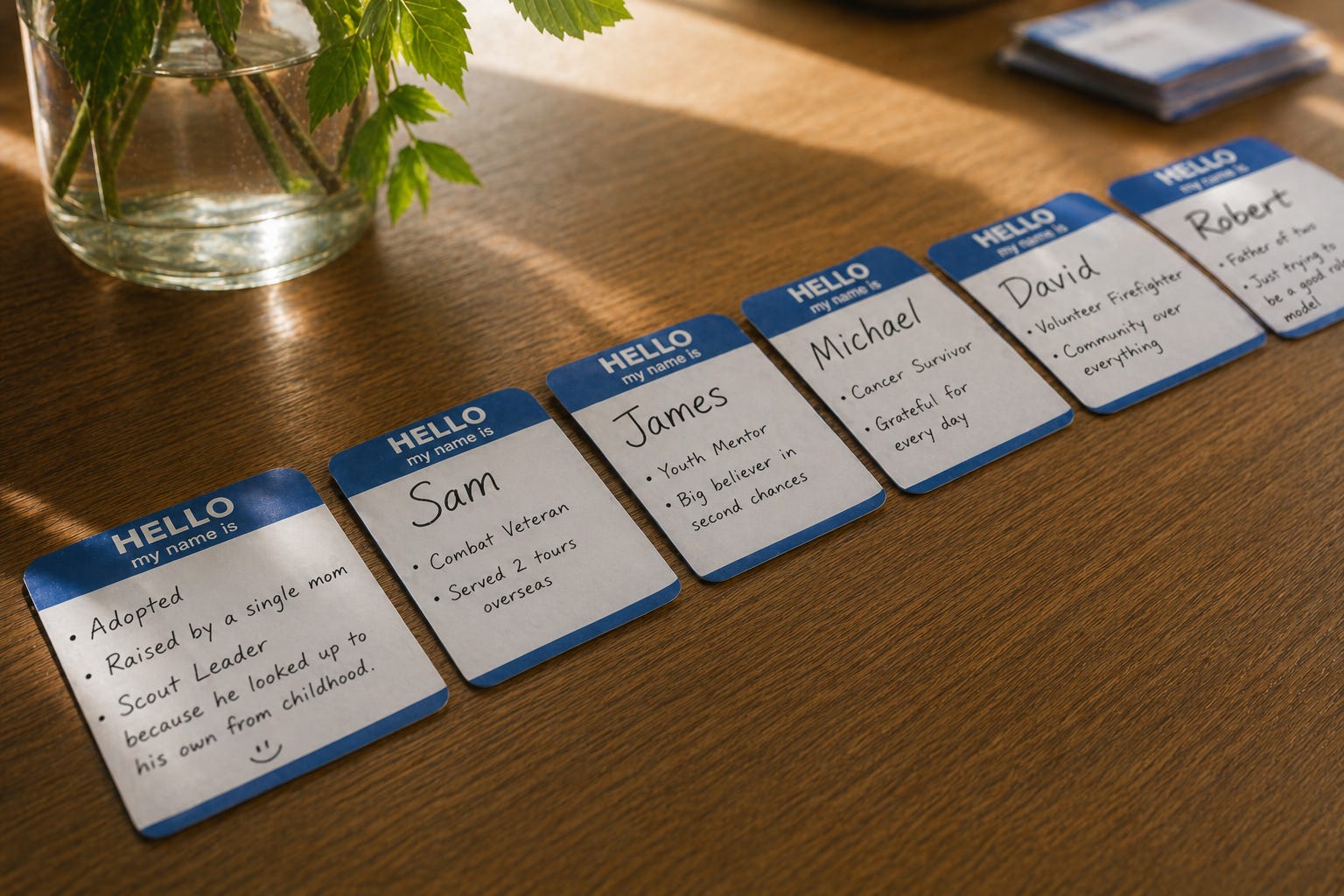
How many Brothers in your lodge do you actually know? Not recognize. Not exchange pleasantries with. Know.
In my own lodge I can name most members’ vocations. I know their names and a handful of surface details. Maybe three men I actually know with any depth, and those relationships formed for reasons that had nothing to do with lodge. The rest I know the lodge version of. The dependable, pleasant man who occupies the same chair, says the expected things, and drives home.
We shake hands, share a meal, sit through the same meetings, and call each other Brother. For most of us that word means we recognize each other. We know each other the way coworkers do. Names, roles, surface facts. And because nobody ever builds a reason to go deeper, we assume the surface is all there is.
The lodge is no different. This is the default setting for adult life in 2026.
“Do not bring your whole self to work.” That was the advice, delivered with the calm certainty of someone reporting the weather. Your work personality should be dependable, responsible, nonconfrontational, and nothing more. Masking, she called it. She was teaching it the way you would teach someone to tie a knot. The comments ran into the hundreds and dissent was almost nonexistent. One person described herself as a golden retriever at work and a black cat everywhere else. Another said “bring your full authentic self to work” sounds wonderful in theory, then added, flatly: do not do it.
Then a woman got fired and the floodgates opened. Hundreds of people sharing what they had learned about managing themselves into acceptable shapes. One had been at her job for two years, in her field, doing work that mattered to her, and not one colleague had ever seen her real personality. Not one. Cordial and professional. That is all they got. Another said her boss tolerated her occasional silliness only because she delivered results and created zero drama.
Then one comment: “you are drastically underplaying this. There are many situations where your personality can get you fired long after you have established your credibility.”
Long after you have established your credibility.
I get it. I taught it. For twenty years I gave every new crew member the same speech. Keep your mouth shut. Not forever, but for now. Learn the job. Ask every question you can think of. Everything we do, and the way we do it, exists for a reason. Until you understand how we got here, be curious instead of clever. Add value. Earn the room. Only then does the rest of you get to come out.
The mask had an expiration date. You wore it while you earned your place, and crossing that line meant the room opened up to you. The deal was honest.
The world those comments describe has no finish line. The performance is permanent. You can be ten years in, respected, productive, and still one unguarded moment from consequences. A probationary period that runs the length of a career.
The woman who has been at her job two years and whose real self remains unseen has just never been in a room that asked.
Most lodges do not ask either.
A men’s group at my father-in-law’s church ran a simple exercise once. Everyone answered questions on paper, anonymously. The group tried to match answers to faces. Then each person got to tell the story behind the answer. Team-building cliché. Except it worked.
One of the men in the group worked for the NSA. Everyone in the church knew that much. Nobody knew anything else. The question: who is the most famous person you have ever met?
The answer was Yasser Arafat.
When it came time for this man to explain, all he said was: “I met him in a receiving line for the King of Jordan.” That was it. No elaboration. No follow-up. Was he part of an official delegation? Standing in an entourage? He did not say, and the room was left to wonder.
My father-in-law told me that story years later. It had lost nothing. One question, asked on purpose, and the answer was still traveling, reaching someone who was never in the room when it happened. The man had sat in that church for years. All it took was someone deciding to ask.
That was one question in one room. I have watched it work with seventy-two strangers at once.
Shoulder to shoulder along the curb outside a gymnasium. None of them have met. Most are already sizing one another up, running that silent calculus humans do in any new group.
I tell them to line up youngest to oldest without speaking. Ready. Go.
It takes a few minutes of pointing, mouthing words, holding up fingers, and some confusion in the middle where three people share a birth year. They sort it out. They always do. The mechanics are not the point.
I fold the line in half. Now they are facing each other in pairs. Oldest with youngest. Second oldest with second youngest. Down the line. I give them a few minutes. Learn where the person across from you is from. Find out something real. Not “we both like football.” Something a handshake would never reveal. Something a level or two below the surface.
The noise changes. It gets louder, but the tone is different. Less performing, more actual laughing. A few people lean in. Somebody’s eyebrows go up.
When I call time and ask pairs to share what they learned, the pattern is invariable. She was a competitive gymnast until she was nineteen. He spent a summer commercial fishing in Alaska. She has played violin since she was six. He grew up on a reservation in South Dakota. None of it was hidden. None of it was hard to get to. Nobody had simply asked.
I ran this exercise for years at the Chief Petty Officer Academy. Students, corporate teams, military units. The outcome never varied. But the exercise was always most interesting in my consulting with intact work groups, people who had shared an office for three or four years. They knew each other’s names, titles, coffee orders. And they stood there visibly surprised to learn that the quiet guy in accounting once toured with a bluegrass band. That the woman who runs payroll is a competitive powerlifter.
That the man they had eaten lunch next to for a thousand days built houses in Honduras the summer after his son died and never mentioned either thing to anyone at work.
They knew each other’s masks. They had never thought to look past them.
Every piece of our symbolic system points toward becoming known. The rough ashlar. The working tools. The progressive degrees from darkness to light. But you cannot lecture a man into removing a mask he has worn so long he has forgotten it is there. What you can do is build a structure that makes the removal easy.
It does not take a retreat. No ropes course. No consultant. It takes a Worshipful Master willing to spend ten minutes of a stated meeting on something other than reading minutes. A Senior Warden who pairs Brothers up before dinner and gives them a real question to answer. Someone in the room who decides that a roster of names and vocations is not what we promised each other.
The Tyler’s sword marks a boundary. Everything outside that door runs on managed versions of ourselves, and millions of people accept that arrangement as permanent. The room inside is supposed to be different. The Brother who has been sitting next to you for five years might have played trumpet in a symphony orchestra. He might have built houses in Honduras. He might have lost a child and never told anyone, because nobody in that room ever asked him anything real.
You will not know until you ask.
-Brother Rob
Rob Linn builds teams, lodges, and nonprofits, and writes about what happens when organizations stop earning the loyalty of the people who show up for them.
Find his books and bio at bosley.press.
It is unfortunate that a place that is supposed to be a haven could become an extension of the other world. Being able to share life's successes and challenges with Brothers and talk about almost anything is one of my favorite parts of Masonry. The downside is we often lose track of time... 🤣
That is quite the interesting famous person for sure!
The Lodge seems more intimate than the workplace, and hence a place for different masks and looser boundaries.