
The First Layer

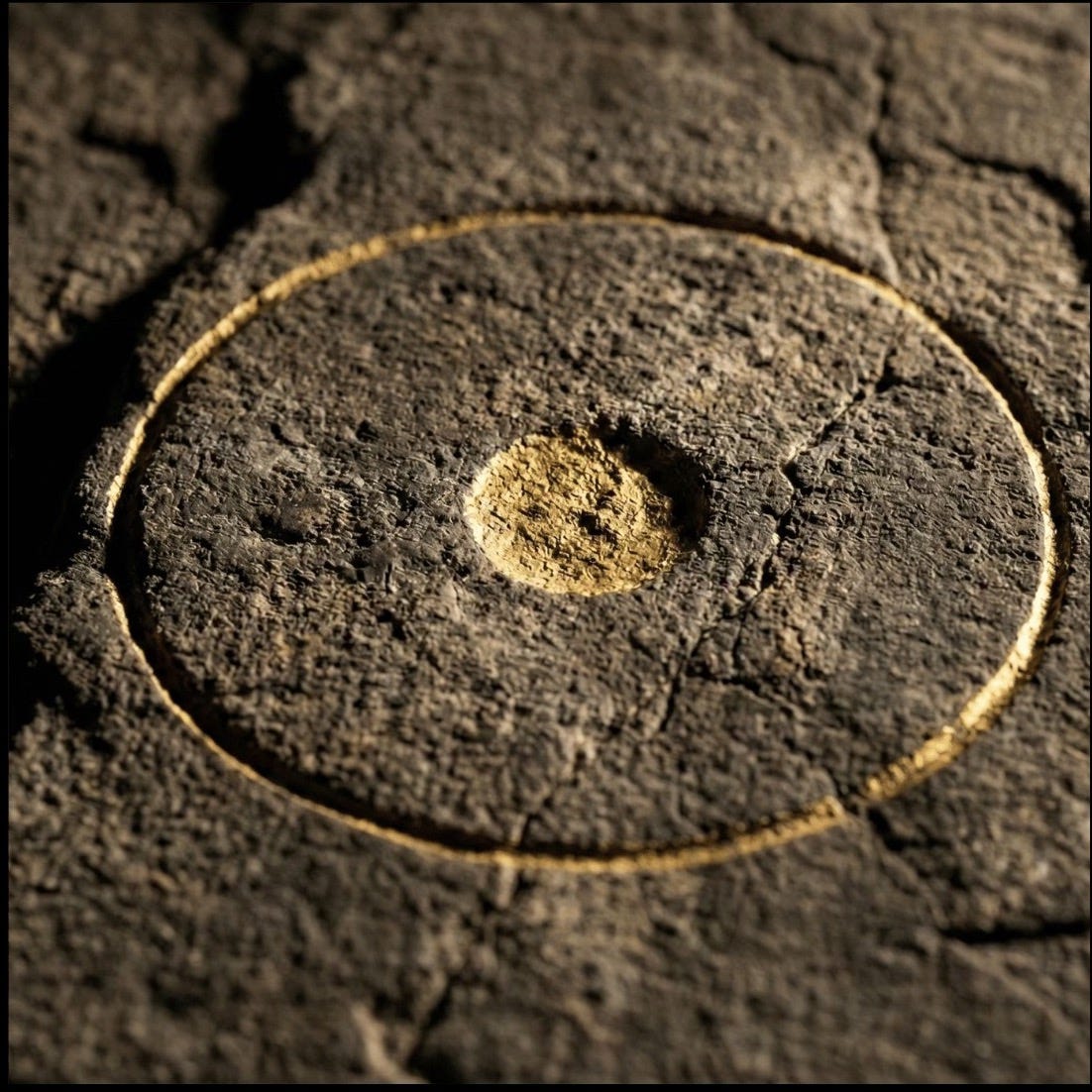
Every Entered Apprentice learns that a certain point within a circle, bounded by two parallel lines representing the Saints John, with the Holy Scriptures resting above, should be found in every regular and well-governed lodge. The point is the individual brother. The circle is the boundary of his duty.
That is one layer. There are others.
In 1902, a young minister named Joseph Fort Newton was raised to Master Mason at Friendship Lodge No. 7 in Dixon, Illinois. He immediately started asking questions. What did the symbols mean? Where did the ritual come from? What was Freemasonry actually about? His Worshipful Master gave him what he had, which wasn’t much, and most of it, Newton later wrote, “was wide of the mark.” A Past Master did better, sharing what Newton called “his exalted conception of the Craft.” But the lodge itself offered nothing beyond the ritual and the catechism. Newton continued to attend, but found that he had “entered seeking knowledge, and finding none,” drifted away.
There is an old saying, often attributed to Einstein, that everybody is a genius, but if you judge a fish by its ability to climb a tree it will spend its whole life believing it is stupid. Newton was a fish. Not a stupid one. A brilliant one, swimming in a lodge that only knew how to teach tree climbing.
The lodge wasn’t broken. The ritual wasn’t empty. The brothers weren’t failures. They just didn’t know what Newton needed, and Newton didn’t yet have the vocabulary to ask for it. So he left. The way seekers leave when they sense there is more but nobody around them can point to where it is.
A few years later, Newton moved to Iowa and discovered the Iowa Masonic Library. Over 250,000 volumes. Thousands of rare Masonic texts. Research from the lodges of England. He found the depth he had been looking for. It had been there the whole time, preserved in the fraternity’s own collections, waiting for someone willing to look. In 1914 he published The Builders, which went through more than forty editions and six translations. It remains one of the most widely read introductions to Masonic philosophy ever written.
Newton’s colleague H.L. Haywood put the lesson plainly: “There is no known way whereby, through a kind of magic, we can find light in Masonry. If a man wishes to learn something of history, he studies it; so if a man would learn Freemasonry he must study it.”
No magic. No shortcut. Self-directed work. But the material is right in front of you if you are willing to look.
Consider the circumpunct.
My mentor pointed out during my first two degrees that our lodge didn’t actually have one on display. If every regular and well-governed lodge has one, and we don’t, he said, what does that make us? The jokes wrote themselves.
The missing display sent me looking. Not for a plaque to hang on the wall. For the symbol itself.
The Egyptians drew it to represent Ra. In their hieroglyphic system it is catalogued as Gardiner sign N5, the sun disc. Third millennium BCE. It shows up on the Palermo Stone around 2400 BCE as a marker for days and celestial events. One of the oldest religious symbols in continuous use.
The Greeks called it the Monad. Diogenes Laertius, in Lives of the Eminent Philosophers, records the Pythagorean teaching that the Monad was the principle of all things. From the Monad came the Dyad. From the Dyad came numbers. From numbers came points, lines, surfaces, solids, the physical elements. Everything that exists, emanating from a single indivisible source. Pythagoras believed the Monad was God and the Good.
The Hindus arrived at the same image with no contact with Greece. They call it the bindu. The Rig Veda, composed around 1500 to 1200 BCE, concludes in its Hymn of Creation that before existence there was neither being nor non-being. Only One Thing, breathing without breath. The Upanishads teach Tat tvam asi. Thou art that. The individual soul and the universal reality are the same thing.
The Heart Sutra says form and emptiness are identical. Ibn Arabi, a 12th-century Sufi philosopher, taught ideas his followers later called wahdat al-wujud, the unity of being. Rumi put it plainly: in the shop for Unity, anything you see there except the One is an idol. The Kabbalah teaches that divine sparks sustain all of creation.
And Paul, standing in front of Greek philosophers at the Areopagus in Athens, told them: “In him we live, and move, and have our being.” Augustine argued evil has no substance of its own. Just the absence of good.
Different centuries. Different continents. No shared language. Same conclusion.
There is an old philosophical exercise. If you dip a cup into the ocean, do you have a cup of water or the whole ocean? Every one of these traditions dipped a cup. Every one of them pulled up the same water.
The word for what they all found is monism. Christian Wolff coined it in 1728. One reality, not divided into sacred and profane, spirit and matter, God and creation. One thing, expressing itself as everything. If everything participates in one divine reality, the gatekeeper becomes unnecessary. No institution can claim exclusive access. So the idea went underground. It hid in symbols. It preserved itself inside organizations that knew how to keep a teaching alive without getting killed for it.
All of that lives inside one dot and one circle. The same symbol the Entered Apprentice lecture describes in a single paragraph, then moves on.
Freemasonry didn’t invent anything. Not a single teaching. Not one symbol. The Craft gathered universal wisdom traditions and dressed them in 18th-century Christian language. The Saints John. Solomon’s Temple. Biblical imagery throughout. The packaging was strategic. Unfamiliar ideas attracted dangerous attention. The costume kept us alive. Mackey traced the point within a circle back through its solar origins and noted that the parallel lines originally corresponded to the solstices, not the Saints John. The Christian packaging fit over the astronomical framework without replacing it.
When you meet on the level, you are enacting the principle that underneath our differences we share the same substance. When you circumambulate the altar, you are the point moving within the circle. The same path the Pythagoreans traced. The same relationship between center and circumference that every contemplative tradition recognized independently.
The ritual tells you all of this. It just doesn’t explain it. That part is yours to do.
Masonic growth can happen through ritual and meetings alone. For some men it does. Men who didn’t grow up in an environment where self-development was modeled or encouraged may find the degrees genuinely transformative on their own terms. The structure, the accountability, the language of moral architecture applied to a life that never had a blueprint. That is real and I would never diminish it.
But for others, the degrees are a door, not a destination. Newton walked through the door in 1902 and found an empty room. Not because nothing was there. Because nobody showed him where to look, and the lodge didn’t know it was supposed to. The fish climbed the tree, decided it was stupid, and swam away.
The depth was always there. It is there now. Not hidden exactly, but not advertised either. Plain sight is the best hiding place, and Freemasonry has been using it for three centuries.
My own background is oneness Christianity. Universalist. Wisdom tradition. The self as the divine experiencing itself. That reading goes beyond what the lectures teach explicitly. To me, the point is not just the individual Mason. The point is the center we return to when our passions exceed due bounds. The center we wander from. The center we find again.
Lao Tzu described this in Chapter 16 of the Tao Te Ching, twenty-five centuries ago:
The ten thousand things rise and fall while the Self watches their return. They grow and flourish and then return to the source. Returning to the source is stillness, which is the way of nature.
The ten thousand things are the circumference. Endlessly expanding. The source is the point. Returning to stillness is circumscribing yourself within due bounds.
Nobody handed me that reading. I found it by looking. The way Newton found the Iowa library. The way any brother finds the deeper layers, by wanting them enough to go looking.
The ritual tells you the first layer. The rest of it has been waiting.
And you can dip buckets all day long. The ocean doesn’t care. It doesn’t run out. Your looking doesn’t diminish what is there for the next brother who decides to look.
None of this requires you to leave your own tradition at the door. Paul said it. Augustine said it. The ritual says it in its own register. The same insight showing up independently across every serious spiritual tradition on earth does not threaten your faith. It confirms it. The circumpunct does not compete with your Volume of Sacred Law. It agrees with it.
Universal truths show up universally. That is what makes them universal.
-Brother Rob
My book The Unfinished Temple, thirty-three meditations following the three degrees designed as working tools for daily labor, is available in paperback and Kindle.
"There are many roads to prosperity, but one must be taken. Inaction leads nowhere." Robert Zoellick
The journey begins when you find the path you wish to walk, and begin to do so in earnest.
I love the quote about the fish climbing a tree. Have a Blessed one and safe Travels!