
Fit for the Builder's Use

In 1887, Harmon S. Palmer patented a machine to make solid concrete blocks. He was convinced this was the future of construction.
The field disagreed. Those blocks weighed 100 pounds each. Workers couldn’t transport them. His revolutionary invention sat unused for seventeen years.
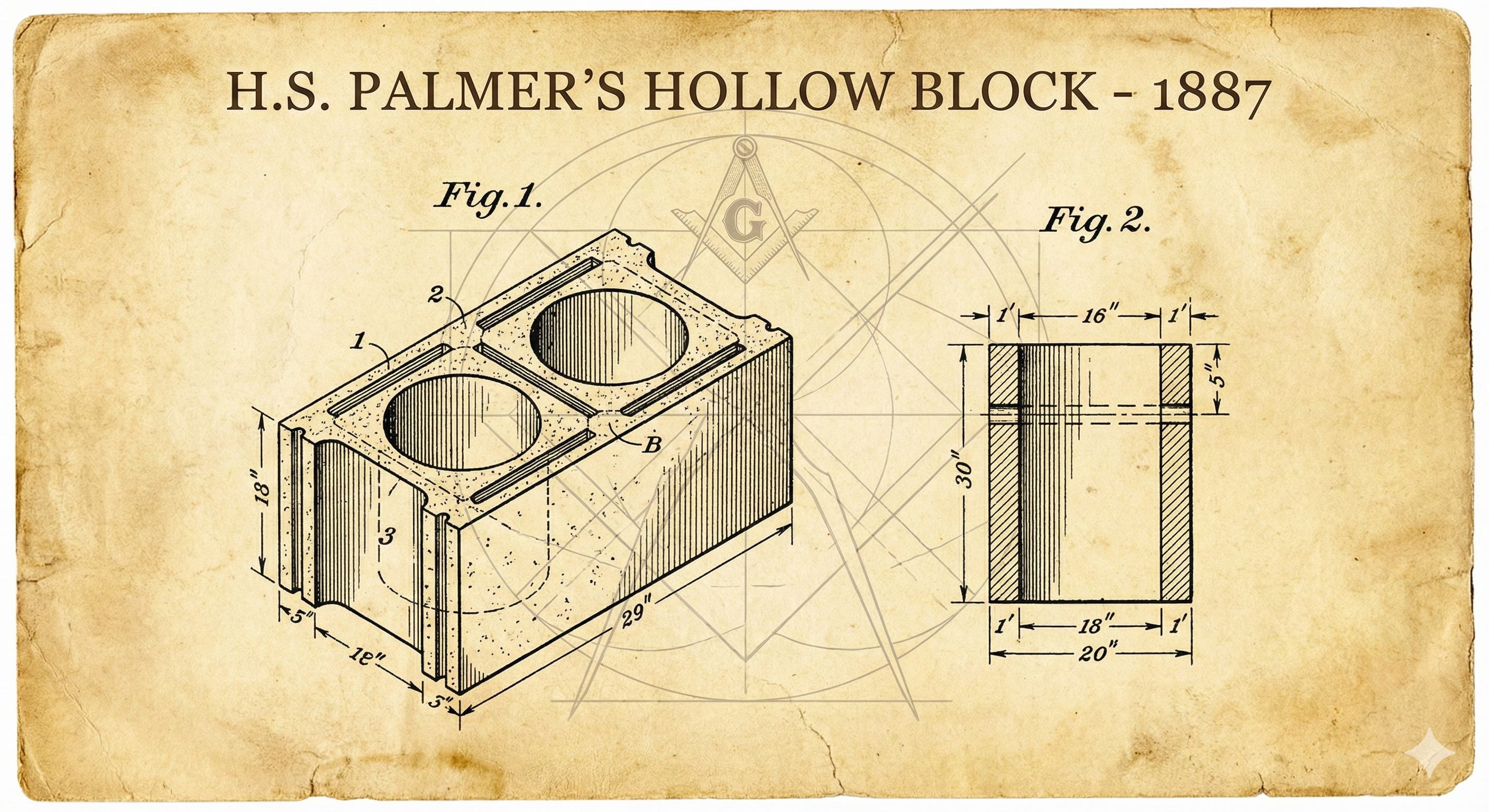
Then Palmer filed a second patent. This time for a block with two-thirds of its mass removed. Two hollow cores running through the center. The weight dropped to 30 pounds.
The hollow block didn’t just become easier to move. It became structurally stronger. Better insulation. Greater load-bearing capacity. The removal of material created superiority.
A few weeks ago I wrote about Oliver Spaulding, the 1881 Grand Master who apologized for giving a statistical report. A Civil War general, a sitting congressman, a man who spent his entire career quantifying things that mattered. And he stood before Grand Lodge and called the numbers “superficial.”
The real work, he said, was happening in a space no annual report could capture. Human passions directed. Sympathies quickened. Dormant moral faculties vitalized. Secret and silent forces.
Spaulding was telling us what matters. Palmer was showing us how to make room for it.
I think about Palmer every time someone tells me their lodge is struggling because they don’t have enough.
Not enough members. Not enough officers. Not enough money. Not enough time.
The assumption runs deep: if we could just add more, more programs, more outreach, more effort, we’d be solid again. Dense. Substantial. Like Palmer’s original block.
But Palmer spent seventeen years learning what every Chief Engineer eventually discovers: the thing is never the thing. The weight wasn’t strength. It was friction. The mass wasn’t substance. It was interference.
Greg McKeown calls this the Essentialist’s dilemma. Most organizations ask “What do we have to give up?” and then grip tighter because they’ve already invested, already carried the weight, already built their identity around doing everything. McKeown says the better question is “What do we want to go big on?” That question assumes you’re an architect, not a curator. It forces you to name the load-bearing wall.
Freemasonry has accumulated a lot of stuff that isn’t load-bearing. We’ve been calling it tradition.
I’ve watched lodges give thirty minutes to reading correspondence and three minutes to education. The priorities are visible. So is the empty parking lot.
I’ve watched degree teams perform ritual like they’re checking boxes rather than transmitting light. Technically correct, spiritually vacant. “We’ve always done it this way” has become more sacred than the meaning the ritual was designed to convey.
I’ve seen lodges cling to buildings they can’t afford, programs nobody attends, offices that exist purely because they existed last year.
And I’ve seen well-meaning brothers propose community events and charity initiatives and public visibility campaigns, all fine ideas in isolation, and watched the lodge say yes because saying no feels unkind.
We keep pouring concrete. Then we wonder why the block is too heavy to carry.
So what do we want to go big on?
If the answer is “friendship,” men can get that at a bar. If it’s “charity work,” they can get that at Rotary. If it’s “networking,” LinkedIn exists. If it’s “tradition,” plenty of churches would love to have them.
But if the answer is something like: We help a man become more than he was, through work that can only happen here.
That’s what Spaulding meant by human passions directed, sympathies quickened, dormant moral faculties vitalized.
That’s the load-bearing wall.
Everything else is decorative. And decoration is heavy.
Michigan Masonry has dropped from over 100,000 members to fewer than 19,000. More than half are over 70. We lose roughly 845 brothers to the Celestial Lodge each year and raise maybe a third of that.
The temptation is to respond with more. More recruitment programs. More marketing. More events to attract attention. Pack the block solid and maybe the weight will feel like substance.
Palmer’s story suggests another path. The lodges that survive this transition might be the ones that figure out what to remove.
Not do less Masonry. Do more concentrated Masonry by cutting everything that dilutes the experience and exhausts the men doing the actual work.
Offices that exist because they once served a purpose nobody remembers. Rituals performed without understanding. Meetings structured for a membership that no longer exists. Properties maintained long past their usefulness. Programs continued because “we’ve always done it” rather than “this still works.”
Palmer’s hollow block didn’t just reduce weight. The air pockets created insulation. The geometry distributed load more efficiently. The voids made steel reinforcement possible.
The emptiness was the improvement.
Spaulding knew the interior work couldn’t be measured. Palmer discovered that the interior space made the structure stronger. McKeown would say they both found the essential by eliminating the trivial.
Same insight. Different trades.
Freemasonry doesn’t need more concrete. It needs us to identify what we’ve been carrying that was never load-bearing, and have the discipline to carve it out.
What remains will hold more than the solid block ever could.
What would you subtract if you genuinely believed the structure would be stronger without it?
—Brother Rob
I really like this post, and the imagery it portrays, much like the relationship between the Ashlar and the Gavel. It reminds me of my interest in 3D design and modeling and a rudimentary understanding of FEA anlysis, identifying the bare minimum required to remain structurally sound, without losing the end state required to meet the objective.
I think you have hit the nail on the head here Brother. Perhaps we need to consider what is actually required to make the Craft work without compromising its structure and integrity in the process...
Thanks, Brother Rob, for your thoughts. You caused me to think of the many brethren who, over many years, have suggested, stated, and sometimes even begged that lodges focus on the moral education of men. While their statements may have made a ruckus at the time, and maybe inspired some lodges to take action, the majority continued to hold business meetings, meals, bingos, raffles, picnics, and other non masonically educational activities ad infinitum. The very thought of a philosophical dialogue on matters of morals, ethics, or even the meaning of the tools and lessons of Masonry, was something that a normal lodge did not do or have time for.
I like you just continue to share the message that Masonry needs to be more that what it has become, with the hope that a brave few continually strive to make it what it should be.
Fraternally, Mike