
Brother, Why That Flag?
Cherished Myths vs. Uncomfortable Truths

I saw you brother, square and compass on one side, Confederate battle flag on the other. I didn't say anything in the moment, but I've been thinking about you ever since. Not with judgment, but with genuine curiosity about your journey.
This isn't a lecture. It's an invitation to do what we Masons do best: seek light through questioning.
What If Everything You "Know" Deserves a Second Look?
We all carry beliefs we've never really examined. They're like old tools in our apron, we've had them so long we forget to ask if they still serve their purpose. But here's what our Craft teaches us: the unexamined stone remains rough forever.
So I'm curious: When did you first learn what that flag meant? Who taught you? And here's the big one, have you ever researched it yourself, with the same rigor you'd apply to understanding a Masonic symbol?
The Adventure of Discovery
Imagine approaching that flag like you'd approach a piece of ritual you didn't understand. You wouldn't just accept someone's casual explanation, you'd dig deeper. You'd trace its origins. You'd study its evolution. You'd seek primary sources.
What would you find if you approached the Confederate battle flag with that same Masonic curiosity?
Here's a starting point: That flag wasn't even the official Confederate flag. It was one army unit's battle flag. The actual Confederate national flags? Most Americans couldn't identify them.
Interesting, right? So how did this particular design become the symbol? When? Why? Who made that choice?
The Timeline Game
Here's an exercise in perspective. Take out a piece of paper and draw a timeline:
Mark when that flag actually flew in battle (1861-1865)
Mark when it reappeared in public life (1940s-1950s)
Note what else was happening during that reappearance
What patterns do you see? What questions does that raise?
Symbols Are Living Things
You know this better than most, you work with symbols every day in Lodge. The square teaches us one thing, the compass another. But what if someone started using the square and compass for something completely different? What if hate groups adopted our symbols? Would their meaning change?
This actually happened to another ancient symbol: the swastika. For millennia, it meant peace and prosperity. Then twelve years of Nazi use poisoned it forever.
Symbols aren't frozen in time. They evolve based on who uses them and why. It's not about what we wish they meant, it's about what they've come to mean through actual use.
A Four-Year Story
Here's something worth pondering: The Confederacy lasted four years. Just four.
What else have you been part of for four years? A job? A relationship? A car lease? Would you define your entire identity by something that brief?
The South has centuries of culture, innovation, music, literature, cuisine, and tradition. Why would anyone choose a four-year rebellion as their primary symbol of heritage? It's genuinely puzzling when you think about it.
The Questions Worth Asking
Brother, I believe you're wearing that flag for reasons that make sense to you. I'm not questioning your intentions. I'm inviting you to question your information.
Have you read what the Confederate leaders actually wrote about their cause?
Have you traced when and why that flag became prominent again in the 20th century?
Have you considered what message it sends to your brothers of all backgrounds?
Have you applied the same scrutiny to this symbol that you apply to Masonic teachings?
The Courage of Curiosity
A stellar friend of mine often says, "When you think you're right, think again. You may still be right, but it's always worth a second look." That wisdom has saved me from countless errors of certainty.
There's another beautiful quote: "Don't cling to a mistake just because you spent a lot of time making it."
But here's the thing, maybe it wasn't even your mistake. Maybe you inherited ideas that were never yours to begin with. We all do. The question is: what do we do when we realize we've been operating on hand-me-down assumptions?
In Masonry, we celebrate the candidate who seeks light. We don't shame him for his previous darkness. The whole point is the journey from not knowing to knowing, from accepting to questioning, from rough to perfect ashlar.
An Experiment in Truth-Seeking
What if you approached this like a research project? Not to prove anyone right or wrong, but out of genuine curiosity:
Read the primary sources, the actual declarations of secession, the Confederate constitution, the letters and speeches of Confederate leaders
Trace the flag's history, when was it used? By whom? For what purposes?
Study the timeline, what happened during those gaps when it wasn't prominently displayed?
Listen to different perspectives, what do historians say? What do your brothers of different backgrounds experience when they see it?
The Mason's Way
We're taught to use the plumb to test our uprightness and the level to meet on common ground. But what happens when the symbols we carry create walls instead of bridges?
You took an obligation to regard the whole human family as one. Does every symbol you wear align with that obligation? It's not about political correctness, it's about intellectual honesty and moral consistency.
An Invitation, Not an Indictment
Brother, I see your passion for heritage. I respect your desire to honor your roots. All I'm asking is that you bring the same critical thinking to this symbol that you bring to your Masonic studies.
Maybe you'll research it thoroughly and still choose to wear it. That's your right. But at least then it will be an informed choice, not an inherited assumption.
Maybe you'll discover things that surprise you. Maybe you'll find that what you thought you knew was incomplete. Maybe you'll have the extraordinary courage to say, "I was working with bad information, and now I know better."
Either way, you'll have done the work. You'll have sought light. You'll have lived up to the Masonic ideal of continuous improvement.
The Brotherhood We Could Build
Imagine a Lodge where every brother has done this work, where we've all examined our inherited beliefs with the same rigor we apply to ritual. Where we've all had the courage to adjust our course when presented with new information.
That's not weakness. That's wisdom. That's growth. That's Masonry.
Your Journey Awaits
The next time we meet, I'd love to hear about your discoveries. Not to judge them, but to learn from your journey. What questions did you ask? What sources did you find? What surprised you?
Because in the end, we're all seeking the same thing: truth. And sometimes the path to truth requires us to question everything we thought we knew.
The working tools are in your hands, brother. The rough stone of assumption awaits your examination. The question is: Are you curious enough to start chipping away?
"The important thing is not to stop questioning. Curiosity has its own reason for existing." - Albert Einstein
What will you discover when you begin?
A Final Thought
Brother, I hope and pray that your display is just ignorance, the kind that goes away when you pour in some light. That's fixable. That's forgivable. That's human.
But if it's not, if after genuine research and reflection you still choose to wear a symbol of division and hate alongside our sacred emblems, then it's not the Confederate flag you should be removing from your cut.
It's the square and compass.
Leave them in the Lodge for us, along with your dues card. Because a man who knowingly stands for inequality has no place in a fraternity built on universal brotherhood.
I believe better of you than that. Prove me right.
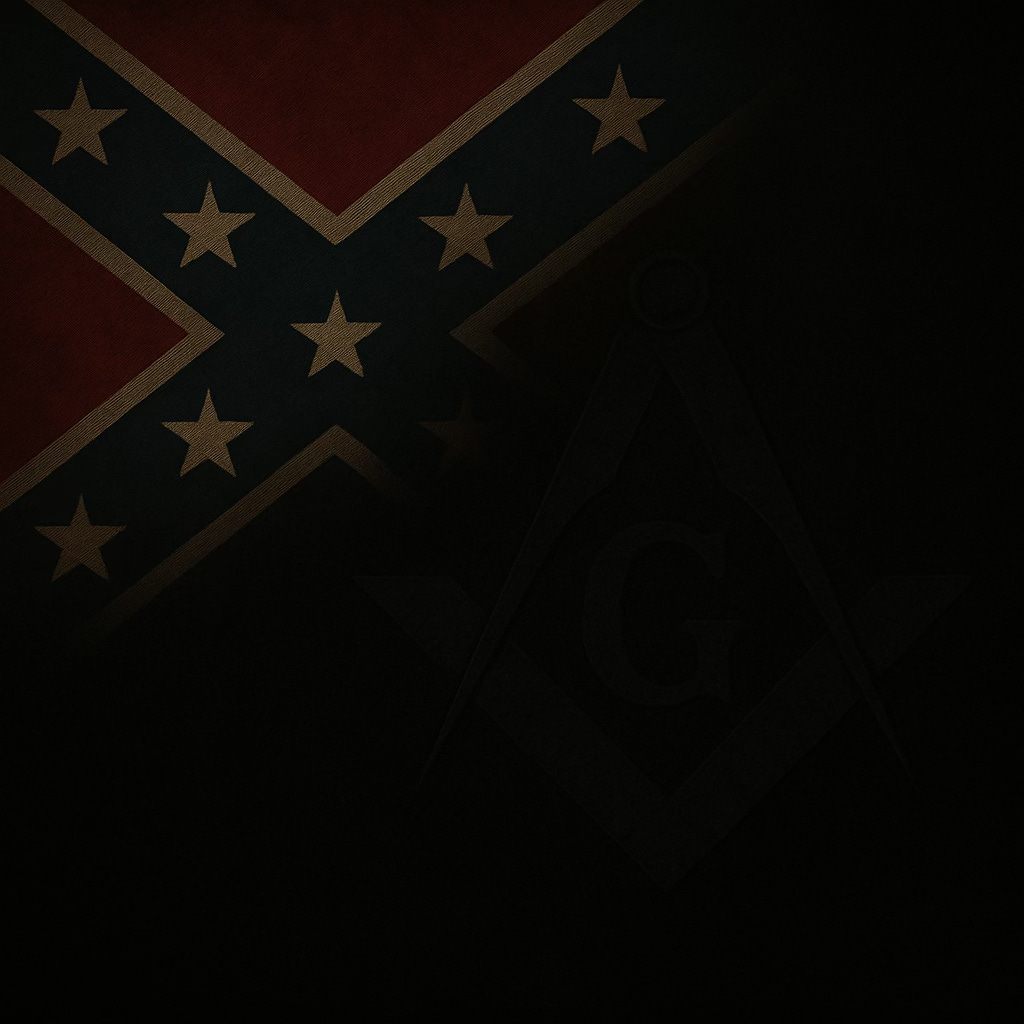
Interesting topic, which brings up a unique perspective of two truths. Therefore neither can contain the whole truth. I have looked into this further than just assuming it's a symbol of hatred and division. As you may have heard the perspective that the original flag in question came from Scottish immagrants (echoing the Saltire flag, with 13 stars for 13 states). They were labeled "rebels" because they refused to conform to government plotical and religious over reach. Many of these immagrants were fleeing the British government who were skilled craftsmen and laborers. Many supported King James if the Stuart family. Those who apposed were known as Hill-Billies, supporters of King William (Bill).
For a little background, those who formed workers unions identified themselves by wearing a red handkerchief around there necks- hence the red necks. They opposed slavery and big corporations paying lower than livable wages, the forefront of corporations and capitalism.
So, just to add some color to this debate, the Rebel Scott's joind in solitary to take a stand against slave wages and over reach of government. They were also joined by various indigenous peoples, such as the Seminole. As a decadent of both, I may see the rebel flag a little more differently than those in popular culture, which deems it a segregational symbol.
I don't take a bended knee to our government, with its private prisons and aligator Alcatraz. As I support those who are in constant turmoil from corporate greed and capitalism, because I see its desire has replaced brotherly love with money and control of those less fortunate. Regardless of nationality or religion, we should all be rebels against injustice and ill treatment of people. Perhaps we are heading towards re-examining and defining our perspective of the rebel flag?
https://youtu.be/SvEe3ZWhCe0?si=XX1gBkFqt1qOsefr